Autore: lapollaz

  • E-STINA

    E-STINA

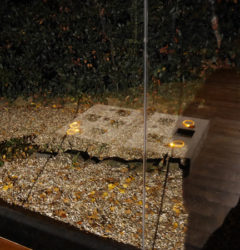
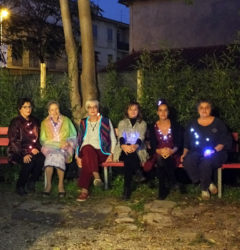
    E-STINA was presented in March 2026 as a solo exhibition at Studio Elisi, Livorno, following an invitation by Anna Rita Chiocca and Sandro Bottari. At the center of the exhibition was a site-specific multimedia installation developed between July 2025 and February 2026 around time, superposition, and the coexistence of personal and political temporalities, through the collection of fragments, recordings, trajectories, and sonic traces connected to a single summer day.

    Developed in continuity with previous research around time, relational temporalities, and layered cartographies, E-STINA approaches time not as a stable linear structure but as something emerging through the interaction between bodies, infrastructures, technologies, landscapes, and political events.

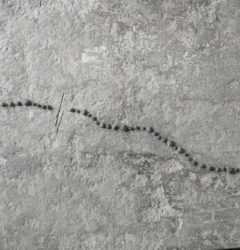
    The work combines video, sound, kinetic mechanisms, projections, and sculptural supports assembled from natural and technological materials accumulated over time in the artist’s studio. Its spatial structure derives from the maritime trajectory of the cargo ship Cosco Pisces, blocked for days off the Ligurian coast in July 2025 while transporting steel destined for Israel’s military industry. Forced to remain in continuous motion while waiting offshore, the ship generated unstable paths across the Mediterranean that became both a visual and structural reference for the installation.

    Three asynchronous video channels, Radio Alhara broadcasts, moving projection surfaces, diffraction mechanisms, green LED filaments, and responsive kinetic elements create an environment that continuously shifts over time. The installation is configured so that no moment fully repeats itself: images, sound, light, and movement constantly recombine through unstable temporal relations.

    The title originates from a photograph taken in Prato in November 2025, where the partially erased graffiti FREE PALESTINA temporarily left visible only the fragment E-STINA.

    The project was developed following an invitation by Anna Rita Chiocca and Sandro Bottari at Studio Elisi, Livorno, whose generosity and openness created the conditions for the slow process the project required, allowing the installation to gradually take shape on its own terms.

    Text by Anna Rita Chiocca

    Noor Hindi, Fuck Your Lecture on Craft, My People Are Dying in DEAR GOD. DEAR BONES. DEAR YELLOW, 2022

    • E-STINA

      E-STINA

      multimedia installation, 2026

  • E-STINA

    E-STINA

    E-STINA is a multimedia installation developed between July 2025 and February 2026 around time, superposition, and the coexistence of personal and political temporalities.

    The work originated from the attempt to focus on a single summer day through the collection of casual fragments and recordings: phone videos of movements by car, screen captures from my computer while working on a 3D model of the moon, a poem found in a book, nutria along the riverbank, the evening wind, and the sound of Radio Alhara.

    On that same day — 29 July 2025 — the cargo ship Cosco Pisces, blocked for days off the Ligurian coast by activists while transporting steel destined for Israel’s military industry, finally docked in the port of La Spezia without unloading its cargo. Those were the weeks in which port workers’ mobilizations between Livorno and Genoa were intensifying, eventually leading to the large blockades of the following autumn.

    During that period I obsessively followed the movements of the ship through maritime tracking systems. Forced to remain in continuous motion while waiting offshore, the vessel traced unstable trajectories across the Mediterranean, producing involuntary drawings on the map. What had initially emerged as a simple temporal test gradually became the definitive material of the work: a fragmented portrait of a day in which intimate temporalities and wider geopolitical events unexpectedly converged.

    The spatial structure of the installation developed directly from the trajectory of the ship itself. Temporal superimposition becomes spatial superimposition: videos, projections, sounds, and objects distribute themselves throughout the space retracing the unstable path of the vessel.

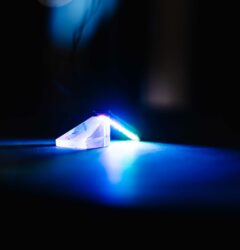
    The installation developed slowly through the accumulation of natural and technological materials collected over time in my studio without a predefined function: roots gathered from the beach, stones from the mountains, fragments of glasses and a laser tube inherited from scientific equipment connected to previous research on quantum mechanics and time. These elements became supports for three projection surfaces, two semi-transparent and one mobile, together with projectors, speakers, electronic circuits, and kinetic mechanisms distributed throughout the space.

    At the center of the installation, a bicycle fragment houses the electronic systems controlling the different actuators and speakers. Through them, Radio Alhara — recorded during the same days in which the Cosco Pisces circulated through the Mediterranean — emerges with the unstable sonic quality of a radio heard from a passing car or through an open window during a summer evening.

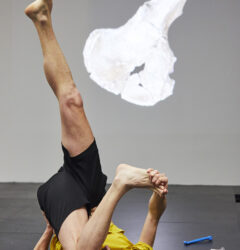
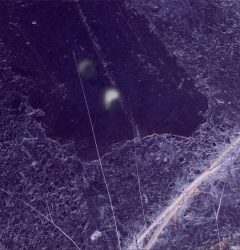
    Alongside the video and sound components, the installation incorporates several kinetic mechanisms. A small fan reproduces the wind of 29 July, causing a lightweight tissue-paper screen to oscillate; a rotating diffraction filter decomposes the projector’s light into unstable spectral reflections over the moon model. Two green LED filaments traverse the installation, casting a diffuse glow reminiscent of the distant nocturnal lights of fishing boats visible from the coastline. Other movements remain purely mechanical, such as a freely rotating screen that shifts through the air displacement generated by visitors crossing the space.

    The entire installation is configured so that it never fully repeats itself. The three video channels and audio tracks operate on different durations and continuously recombine through asynchronous loops, while the kinetic elements introduce further instability and variation. Light, sound, projections, and movement remain in constant drift, producing temporary alignments that cannot be reproduced identically twice.

    Continuing a broader research developed across previous works around relational temporalities and layered cartographies, E-Stina approaches time not as a stable linear structure but as something emerging through material relations between bodies, infrastructures, technologies, landscapes, and historical events.

    The title of the installation originates from a photograph taken in Prato in November 2025, where municipal workers had partially removed the graffiti FREE PALESTINA, leaving only the fragment “E-STINA” visible on the wall for an entire weekend before completing the erasure. This accidental trace, simultaneously disappearing and persisting, became an image for the temporal condition the work attempts to hold onto.

    The installation was conceived following the invitation by Anna Rita Chiocca and Sandro Bottari at Studio Elisi, Livorno. Read the accompanying text by Anna Rita Chiocca.

    Project

  • An entangled time machine

    An entangled time machine

    An entangled time machine was developed in 2023 within the framework of the collaboration between La Science de l’Art — the art and science biennial organized by the Collectif pour la Culture en Essonne — and Grasping the Cosmos, the art and science program curated by Valeria D’Ambrosio and promoted by Villa Galileo, the Galileo Galilei Institute for Theoretical Physics and the University of Florence Museum System.

    The project developed through research residencies in Paris and Florence and visits to scientific laboratories referenced throughout the work. First presented at La Piscine d’en Face, Sainte-Geneviève-des-Bois, in 2023, the installation later became the core of the solo exhibition of the same title at Villa Galileo, Florence, curated by Valeria D’Ambrosio and presented together with a broader constellation of related works.

    Developed in dialogue with physicists Nicola Poli, Valentina Parigi, Riccardo Sapienza, and Caterina Foti, the project draws from encounters with the LENS laboratories in Florence and Kastler Brossel in Paris, exploring how quantum physics reshapes our understanding of time as relational, unstable, and entangled.

    Booklet

    Public Program

    Works

  • Regressive Time

    testo pubblicato per xxx….

  • AR – Augmented Resistance

    AR – Augmented Resistance

    AR – Augmented Resistance, Augmented reality web app, 2025

    in collaboration with Luca Sguanci,2025 – ongoing

    Augmented Resistance is part of a developing archive that brings together researchers, activists, artists, and workers to trace and preserve the memory of workers’ struggles in the Prato textile district and beyond.
    Through an augmented reality web app, it allows users to visualize, within the urban space, sites transformed by uprisings and to reconstruct the memory of labor struggles.
    The project makes the locations of these fights and their resulting changes visible, turning the urban space into a living, accessible archive of collective memory.

    https://www.toccaunotoccatutti.net/demo/archivio/

  • Bowl, Stone, Sunflower, Lightbulb, Tempered Glass, Swan, Superhero, Coffeepot

    Bowl, Stone, Sunflower, Lightbulb, Tempered Glass, Swan, Superhero, Coffeepot

    Video projection, sound installation, composition of objects (glass, aluminum, copper, paper, LED light, electrical cables, plastic, stone), 2024

    Developed within Nuovi Equilibri, a project by FAMA realized in collaboration with Mah,Boh! – Officina delle Possibilità and Fondazione Jorio Vivarelli, curated by Giacomo Bazzani and supported by ToscanaInContemporanea, the work originated through a series of participatory workshops exploring unstable forms of balance through performance, sound, and collective imagination. The workshop was developed together with young artist Dafne Di Vaia, who assisted the project and realized its photographic documentation.

    Starting from the invitation to temporarily “become” something different from oneself, participants experimented with unfamiliar forms, sounds, gestures, and balances, collectively exploring unstable relations between body, imagination, and matter.

    Each participant chose an object, figure, or material — a bowl, a stone, a sunflower, a superhero, tempered glass, a swan, a coffeepot — attempting to embody its posture, movement, and sound through performative actions and vocal experimentation. The resulting work combines photographic documentation of the performances with a sound composition built from the recorded voices and noises produced during the workshops. During a second session, participants collectively constructed and repeatedly rearranged temporary compositions using objects associated with the chosen figures, exploring unstable relations of balance, tension, proximity, and transformation.

    Balancing between play, performance, and collective transformation, the project explores imagination as a way of temporarily inhabiting different states of being and constructing alternative forms of equilibrium.

    The work was presented within the exhibitions organized at Fondazione Jorio Vivarelli and at MAC,N – Museo di Arte Contemporanea e del Novecento.

    A catalogue accompanying the project was published by Metilene Edizioni.

    Performance documentation by Tina Salvadori Paz

    Installation views @Fondazione Jorio Vivarelli, 16.11/2024 and @Mac,n – Museo di arte contemporane del Novecento, 15.12/2024. Ph. Dafne di Vaia, Tina Salvadori Paz, Luca Sguanci

  • Generation of Entangled Photons

    Generation of Entangled Photons

    Created for the 2025 edition of Diario Rizomatico, this contribution extends the research initiated in An Entangled Time Machine through the format of an artist’s diary.

    The work combines a photograph taken during Valentina Parigi’s experiments on the generation of entangled photons at the Kastler Brossel Laboratory (Paris) with handwritten transcriptions of Valentina Parigi’s own words describing the experimental apparatus and the physical processes taking place inside the nonlinear crystal, together with an essay that interweaves quantum physics, family history, colonial violence, poetry, and the emergence of time.

    The essay traces a constellation of references spanning the EPR paradox, Mussolini’s invasion of Ethiopia, John Bell’s theorem, Noor Hindi’s poetry, and recent developments in the relationship between entanglement and time.

    Published in the sixth edition of Diario Rizomatico – Weekly Diary 2025, a self-published editorial project curated by Sandra Nastri and Simona Lotti, featuring contributions by Alessandra Greco, Cinzia Delnevo, Karl Böhmer, Massimiliano Barachini, Meri Iacchi, Tatiana Villani, Tina Salvadori Paz, Valentina Ferrari, and Eva Perini.

  • An entangled time machine

    An entangled time machine

    In an era fraught with ecological, social, and political upheaval, the concept of time becomes precarious, prompting us to reevaluate its significance. Karen Barad’s philosophical research encourages an examination of how quantum physics has reshaped our understanding of time.

    Embarking on a collaborative journey alongside physicists Nicola Poli, Valentina Parigi, Riccardo Sapienza, and Caterina Foti, I ventured into the research laboratories of LENS in Florence and Kastler Brossel in Paris, seeking to unravel the implications of quantum physics on our conception of time.

    This exploration birthed two ‘time machines,’ not in the conventional sense of linear time travel but as symbolic embodiments of time as relational. Inspired by the complex experiments conducted in these laboratories, these machines challenge the traditional notion of a fixed, universal time, instead evoking the complex concepts of quantum correlations, superposition, and entanglement.

    The project finds its home in Villa Galileo, perched on Arcetri hill in Florence, where Galileo Galilei once resided under house arrest for his “heretical” views. This historic setting serves as a fitting backdrop for grappling with radical questions at the intersection of science, society, and politics.

    Every single vibration

    electronic devices, led matrix, flexible led filaments, glass laser tubes, volcanic rocks, glass lenses, mechanic clock mechanism, mud, bacteria, chicken wire, speakers, sensors, color photograph, celestine crystal, strontium aluminate paint, aluminum profiles, black MDF wood. 100 x 180 x 130 cm.

    Every single vibration, inspired by the optical atomic clock developed at the Lens laboratory, incorporates various oscillations from natural and cultural systems. These include historical measurement tools like a volcanic rock pendulum and a sundial made of porcupine bristles, as well as biological rhythms such as those of geobacter bacterial colonies. Visitors activate the machine through their heartbeat, which synchronizes with the flow of Alice Munro’s short story “The Moons of Jupiter” on an LED matrix. Other rhythms, like a leaf swaying in the wind, are captured by an accelerometer, connecting diverse vibrations to the concept of time and matter interaction.

    Radical experiments in correlation

    electronic devices, liquid crystal valve, glass pieces, colored wires, silver rings, vibe motors, led matrices, video projector, beam splitters, aluminum profiles, black MDF wood. 50 x 400 x 150 cm

    This machine draws inspiration from key concepts of quantum physics like superposition and entanglement, which defy classical physics principles, and their connection to time. The first part recreates a recent experiment by Riccardo Sapienza’s team, simulating the double slit in the time domain with a minimalist setup. Multicolored light and oscillating wires represent interference patterns in the frequency domain. The second part reflects Valentina Parigi’s experiments in Paris with nonlinear crystals to generate entangled states of light. Vibrating rings on colored strings symbolize entangled photons, leading to a miniature cinema showing a video from the AAMOD archive, where black and white images are diffracted into colors via beam splitters, symbolizing quantum correlation in time. This video choice signifies our collective effort to reshape time and history, fostering interconnectedness and our shared responsibility towards the future.

    An entangled time machine was conceived and realised for the tenth edition of the art and science festival La Science de L’art, organized by the Collectif pour la Culture en Essonne in Sainte-Geneviève-des-Bois, France, in collaboration with the Grasping the Cosmos project, coordinated by Villa Galileo (Museum System of the University of Florence) and the GGI – Galileo Galilei Institute for Theoretical Physics, Florence. An entangled time machine also became the title of Tina Salvadori Paz’s solo exhibition, curated by Valeria D’Ambrosio, hosted at Villa Galileo in Florence in November 2023.

    More on the exhibition

    Photo credits for the project: Giulia Lenzi, Andrea Abati, Luca Sguanci 

    More on Grasping the cosmos

  • The Time of the Stars

    The Time of the Stars

    The Time of the Stars is a site-specific sound installation created for the exhibition An Entangled Time Machine and installed in Galileo Galilei’s former study at Villa Galileo.

    The work departs from the configuration of the night sky above Villa Galileo at the exact date and time of the exhibition opening. A recorded voice successively names the visible stars and, after each one, pronounces a year: these dates correspond to the moment when the light reaching Earth in 2023 departed from each star, calculated from its distance in light-years.

    The installation unfolds the celestial vault as a coexistence of multiple temporalities: what kind of present is that of a night sky? What historical events, personal memories, and collective histories might a starry sky evoke?

    Installed alongside YPJ–Jineology in the room where Galileo once observed and studied the stars, the work formed the concluding section of the exhibition, bringing together distant stars, political utopias, and collective histories within a shared field of temporal imagination.

    Voice: Valeria D’Ambrosio

  • 8×5 led

    8×5 led

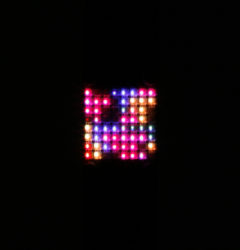
    8×5 – LED is an LED matrix “adapted” as a portable sign for the demonstrations of the 8×5 Movement, supporting strikes for the dignity of workers in Prato’s textile industry. The device only activates when kept in motion, symbolically evoking the need for active participation, and displays two emblematic slogans of the movement: “8×5” and “Tocca uno, tocca tutti” (“Touch one, touch all”).

  • Tutti presenti

    Tutti presenti

    Tutti presenti (All here) is a video combining archival footage of workers’ struggles from the 1950s–70s with images from the March for Freedom, Rights, and Dignity, held in Prato in December 2022. The silent scenes of the march merge with voices from historical films of the labor movement, creating a dialogue between past and present. The title, taken from a song by the striking workers of Apollon, evokes the continuity of struggle and the shared presence of all those stories across time.

    The project was born within the exhibition Arte e Lotte Operaie, curated by the collective ToccaUnoToccaTutti, an initiative launched in 2021 that brings together artists, theorists, and art professionals in a shared effort to support the struggles of workers in the Prato textile district.

  • Piazza Alpi-Hrovatin 1889-1994

    Piazza Alpi-Hrovatin 1889-1994

    https://www.valentinalapolla.it/piazza-alpi-hrovatin/

    This work was commissioned by the Il Prisma project and curator Angelika Stepken as part of an exhibition in the Le Piagge area, a public housing district on the outskirts of Florence.  Built in the 1980s in response to a housing crisis, the neighbourhood was constructed in isolation from the rest of the city and lacked services. It was soon marked by social issues, crime and institutional indifference. However, starting in 1994, thanks to the efforts of Don Alessandro Santoro and the Comunità delle Piagge, the area has been transformed into a hub for solidarity initiatives, mutual aid projects, and grassroots organisation.


    The square in front of the community centre is dedicated to the memory of journalist Ilaria Alpi and cameraman Miran Hrovatin, who were killed in Mogadishu on 20 March 1994 in circumstances that were never clarified. At that time, the international mission Restore Hope (1992–1994) was underway in Somalia, a country engulfed in civil war following the collapse of Siad Barre’s regime. Somalia, an Italian colony from 1889 to 1960, had maintained close political and economic ties with Italy even after gaining independence; these ties were often characterised by exploitation and corruption. The story of the two journalists is intertwined with these shadowy relations, including arms trafficking, toxic-waste dumping, questionable cooperation projects (such as fishing boats, roads and wells), and the involvement of Italian intelligence services.

     I retraced the places linking the journalists’ story to the history of Italian colonialism: from the late-19th-century penetration expeditions—during one of which Ilaria Alpi’s grandfather was murdered; to the road traveled during the journalists’ final journey, beneath which toxic waste is suspected to have been dumped, originally built by Fascist troops during the Migiurtinia war; and finally to Cape Guardafui, with its lighthouse shaped like a fascio littorio, where the cooperation ships suspected of carrying weapons—on which the journalists were investigating—were seized.

    I gathered numerous archival sound materials and interwove them with a textual narration read by Cristina Abati to create twelve audio tracks, each dedicated to a place in Somalia and positioned within the Piagge area according to the correspondence between the two maps, accessible through a geolocated web app.

    Like many Italian mysteries, the murder of Ilaria Alpi and Miran Hrovatin remains unresolved to this day, despite decades of investigations and inquiries, marked by cover-ups and false scapegoats. The audio tracks piece together this complex story in fragments, revealing a century-long history of colonialism, corruption and racism that continues to resonate in the present.

  • Behind the Mountain Range, Somewhere

    Behind the Mountain Range, Somewhere

    Behind the Mountain Range, Somewhere is a site-responsive intervention developed in different landscapes in France, Austria, and Italy. The project emerged from a shared reflection on the ecological transformations of the present and on the need for new ways of understanding nature beyond the opposition between society and environment.

    The work consists of fragments of texts by contemporary philosophers, scientists, artists, and historians placed directly within the landscape. The selected quotations propose alternative ways of thinking about nature, emphasizing interdependence, co-becoming, and the complex networks of relations linking humans and non-humans.

    Two versions of the project have been realized. In the first, the texts are written directly on stones found on site. In the second, developed in a forest where stones were absent, the sentences are encoded through a simple color-based alphabet and distributed across wooden sticks together with a key for deciphering them. In both cases, reading becomes inseparable from walking, searching, and paying attention to the surrounding environment.

    Rather than presenting nature as a distant place existing “behind the mountain range, somewhere,” the work approaches landscape as a field of relations in which biological, historical, social, and political processes are deeply entangled.

    Sites and Texts

    It is extremely frustrating. Many people still believe that society and nature are two different things.” J. Moore, Capitalism in the web of life 2018. Vinci, 2021

    Les grandes accellerations a partir de la seconde guerre mondiale ont laisse des traces sur les roches dans les eaux, le ciel et sur toutes les creatures.” Donna Haraway, Staying with the Trouble: Making Kin in the Chthulucene (2016), Francia St pierre des Champs, 2021

    All life is actively, creatively, incessantly engaged in environmental-making.” J. Moore, The Value of Everything? Work, Capital, and Historical Nature in the Capitalist World-Ecology, 2014 Lermoos, Austria, 2021

    Actually, ecology is: paying attention to the webs of relationships that you are enmeshed in.” D. Donald, On What Terms Can We Speak? Lecture at the University of Lethbridge, 2010
    Montespertoli (FI), 2022, Per Un sentiero di segni, curated Alessandra Scappini

    “Nature is not simply the landscape we see from behind a picture window, in a moment disconnected from those that preceded and will follow it; nor is it vista from a lofty mountain peak.
    M. Bookchin, The Philosophy of Social Ecology, Essays on Dialectical Naturalism, 1996. Montespertoli (FI), 2022, Per Un sentiero di segni, curated Alessandra Scappini

  • Carrara White

    Carrara White

    Carrara White employs 3D animation to explore the mining operations prevalent in the Carrara white marble quarries of Italy. Famous for supplying marble to renowned artists such as Michelangelo and his contemporaries, the Apuan Alps now confront extensive extraction practices. With around four million tons of marble extracted annually in the Carrara region, more than 80% is crushed into powder to produce calcium carbonate for various industrial uses, endangering the entire ecosystem. The video contrasts scenes of mountain pulverization with images of marine organisms crucial to marble formation, whose shells are susceptible to dissolution from ocean acidification. This video served as a supportive tool for the Athamanta environmental activist group based in Carrara.


    Carrara White, installation view at Villa Galileo, Florence, 2023, for the exhibition “An entangled time machine”, curated by Valeria D’Ambrosio